Writing has never been easier. We can dictate novels into phones, collaborate across continents, edit anywhere. And yet most aspiring writers never finish a book. Few write a second.
Why?
Because technology solved the wrong problems. We got spell-check and cloud sync, but the hard parts—staying disciplined, keeping the story straight in your head, the sheer endurance of 120,000 words—those haven’t changed at all.
I know this personally. Five novels written by hand (one still waiting for its final scenes—life happened). Multiple NaNoWriMos. Lessons about writing, and about myself. The truth most writers know: we love having written, but not always the writing itself.
Here’s the thing: storytelling is natural. Humans have told tales since the dawn of time. But sustained, structured writing, that’s work. Long-form storytelling demands discipline, organization, revision, iteration. Our brains love stories, but they don’t love tracking plot threads across dozens of chapters.
The gap between the storyteller inside us and the writer we struggle to be. That’s where tools matter. We’re cooperative, tool-using primates. We’ve always been.
My Journey Through Writing Tools
I started with pen and paper as a kid, stories sprawling across notebooks. Then came a typewriter as a teen, clacking away with physical commitment to every word. WordPerfect on my Amiga opened up editing freedom I’d never imagined. Modern word processors made revision effortless.
Then Scrivener and yWriter changed everything again. Finally, specialized tools built for storytellers: scene management, research integration, story bibles at your fingertips. Structure without constraint.
But I still hit the same walls. Discipline. Coherence across a hundred thousand words. The exhausting mental overhead of remembering everything.
When GPT-3 appeared, I paid attention. I fine-tuned GPT-3.5 into a barely coherent rephrasing tool—and gave up on it. Then came SudoWrite and NovelCrafter, and suddenly I saw the glimpse of something genuinely new. AI that could suggest, draft, transform. Creative partners, not just passive notebooks.
I loved the energy. Hated the SaaS lock-in. Paywalls everywhere. Subscriptions. Rent your creativity forever.
I didn’t want that.
Building My Own Path
So I built my own tools. First, a scrappy prototype inside ChatGPT itself: copy, paste, prompt, repeat. It worked. Then came Writingway: my first real writing assistant. Connected to endpoints, generated prose, organized drafts like those commercial tools, but locally, affordably, transparently.
Then came the rewrites. Feature creep. Dependency hell (classic Python). UX friction. I realized fixing it would take longer than rebuilding cleanly.
So I did exactly that.
Writingway 2 was leaner, more flexible, more beginner-friendly. But as I built, a new thought crystallized:
We don’t just need a better editor. We need a creative ecosystem built around AI collaboration.
Not a tool that writes for you, but one that writes with you.
The Next Step
After typewriters came word processors. After word processors came specialized writing software. After that came “chunk your scene and let AI help” tools.
The next step is multi-agent story creation.
Control Room is my attempt at that future. Not another text editor or prompt window—a full writing IDE, built for long-form storytelling the way VSCode is built for code.
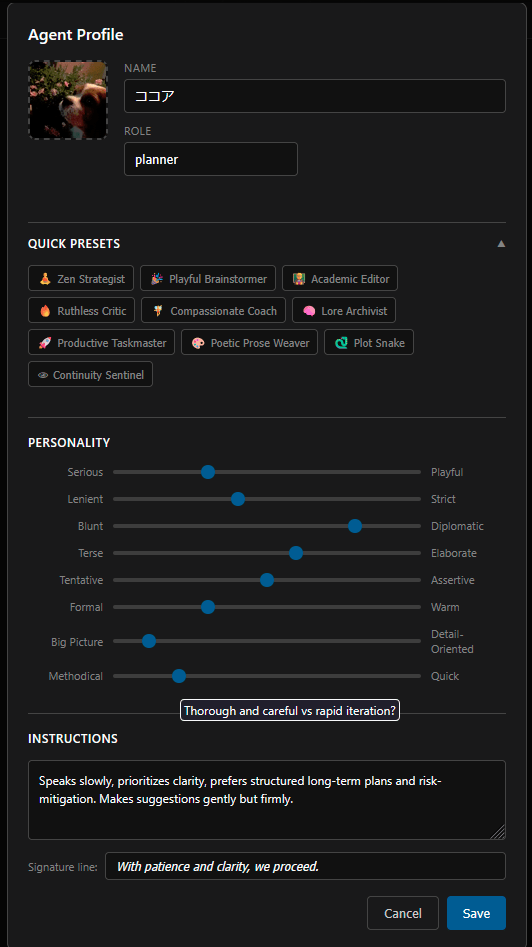
At its heart: multiple AI agents, each with their own role, memory, responsibilities, and personality. A planner. A critic. A continuity guardian. A lorekeeper. A prose stylist. Instead of dumping prompts into a void and hoping context sticks, Control Room uses persistent memory architecture: a swarm memory bank where agents communicate through searchable issue threads, with personal tagging and a sophisticated interest system that compresses old memories into semantic traces.
The story becomes alive. Not static files in folders, but living context the system understands and works with. You write by chatting, planning, drafting, revising inside one conversation-driven environment, with your AI collaborators at your side.
It works with local models. No SaaS lock-in. Creativity shouldn’t be rented monthly.
A Future Worth Building
Imagine telling your story like humans always have (speaking, brainstorming, iterating) while AI partners structure, shape, and polish it into a novel. Your voice remains yours, but you’re no longer alone at the desk.
Not tools. Extensions of yourself.
A place where creativity scales. Where ideas flow instead of stall. Where finishing a novel isn’t a solitary endurance test, but shared effort between human imagination and machine assistance.
The future of writing is collaborative.
And I can’t wait to build it.
 A. Omukai
Love the concepts behind your “Control Panel.” Please keep us well-informed at every stage of development. I’ve basically left NC behind and am now using Claude 4.5 Sonnet in an Anthropic Project instead. I love working in “spiral dialog” with Claude. It’s a term Claude came up with. We work similarly to what you described in your last blog post. The experience is amazing and wonderful. Keep up your good work. I look forward to seeing where you take this!~ Zy
LikeLiked by 1 person
Hello brother! Are we able to adjust the temperature of the API in the writngway? i have the api token can i adjust the temperature in this tool?
LikeLike
Writingway (2) has advanced AI settings, but I’d recommend going with the default values.
LikeLike
Thanks! and sorry for the late reply. I’ve been working a lot on this and have made good progress, but this is a whole different level from Writingway, in regards to complexity, so it’ll take a bit more time 🙂
LikeLike